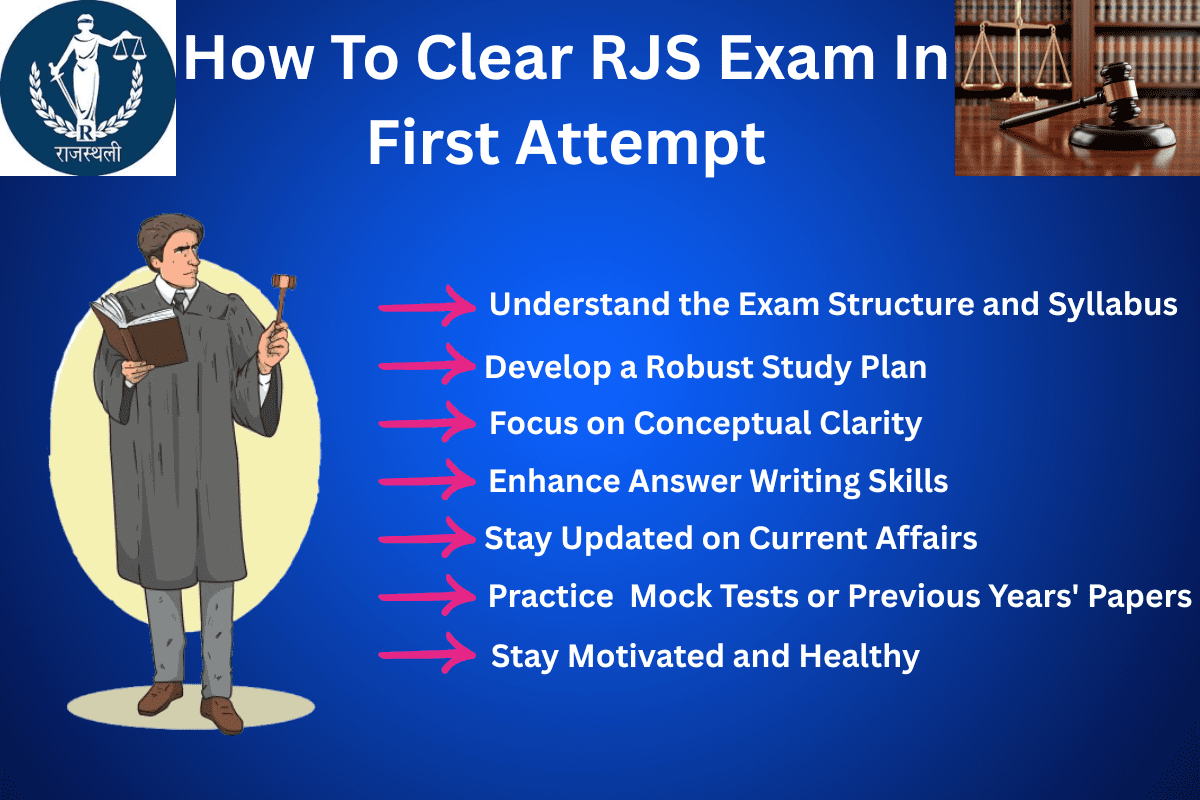
How To Clear RJS Exam In First Attempt
What is RJS Exam?
RJS (Rajasthan Judicial Services) Exam serves as an incredibly prestigious entrance exam for individuals aspiring to fulfill the role of Judicial Officer in Rajasthan. The RJS Exam is conducted for the recruitment of Civil Judges in the state since it offers opportunities pertaining to the highly coveted position of Judge; a complete Judicial Officer. Thus, passing the RJS Exam enables individuals to take on the responsibility of being an authority that possesses the power to interpret law, administer justice, and impact people’s life.
The majority of cleared exams, RJS assess your knowledge of law, a series of ethics, language, and reasoning. If you are planning to clear the RJS Exam at your first attempt, it will require your 100% dedication, discipline, and strategy.
Let’s be clear about something – RJS is no government job exam. RJS is not for the faint of heart. Taking RJS requires Massive memory, excellent grasp of the law, and the ability to think on your feet. The syllabus of RJS exam is broad and because of high number of students the competition is very competitive.
Who conducts the RJS Exam definition?
The RJS Exam is conducted by the Rajasthan High Court, along with the Rajasthan Public Service Commission (R.P.S.C). It is conducted periodically, as per the vacancies available in the judicial system. To make it clear, the Rajasthan Judicial Service examination is conducted at every level of the examination with utmost seriousness and clarity, as the judiciary is the backbone of the democratic structure.
Once you’ve successfully cleared every level of the exam, you are appointed as a Civil Judge-cum-Judicial Magistrate, starting with judicial training, and a few weeks later you really get to sit in charge of a court, in truth, it is as responsible and lawful as it gets. Getting selected in the first go, is a cake day.
Why is RJS one of the toughest exams?
The number of vacancies in RJS exam is very minimal. When there are many thousands of applicants with only a few positions, it becomes a very tight competition to join the top tier applicants. Secondly, the syllabus is vast, essentially covering all procedural laws, most substantive laws, language skills, general knowledge, and plenty more.
Furthermore, the assessment standard is much higher than most competitive exams. It is not good enough to know the law; when you respond to questions you must present that knowledge clearly, concisely, and correctly. Answers are commented on not only in terms of correct information, but also for logical presentation of legal insight as well.
Lastly, it requires more than just preparation at many levels – it requires preparation in three stages at which every stage is challenging: Prelims, Mains, and Interview. You will have to keep the energy and commitment up for months, sometimes years for many candidates. That is why the early starters and strategic planners do so well.
Comprehending the RJS Exam Pattern
Preliminary Exam
The first exam or we can say initial phase is preliminary exam. It is objective type and mainly a screening test/ exam. Generally, the paper will contain 100 objective multiple-choice questions all carrying equal marks and the duration is 2 hours.
The subjects will include
Indian Penal Code (IPC)
Criminal Procedure Code (CrPC)
Civil Procedure Code (CPC)
Indian Evidence Act
Constitution of India
Transfer of Property Act
Contract Act
General Knowledge
English proficiency & Hindi proficiency
But here’s the catch, this paper is not simply about memorization. This paper tests your comprehension and your expression of law. The main component to prepare for exam a great time management is play a very vital role. You have on an average one minute per question, so you need to be efficient and succinct.
Mains Examination
Again, the Mains examination is where it actually counts. This is a descriptive written type of examination which consists of four papers.
Law Paper-I (Civil Law)
Law Paper-II (Criminal Law)
Language-Hindi Essay
Language-English Essay
The papers are designed to evaluate not only your knowledge but your ability to communicate. You need to write comprehensive answers using legal reasoning, case law and from a structured perspective. For most people, this is the most difficult section since writing has to be perfected just like your knowledge base. One of the first mistakes that aspirants make is ignoring the language. These papers are not optional courses, they count for something and can either be a pass or fail for you, so ensure that both your legal and language tools are sharpened up before entering the examination hall.
Interview Round
The final frontier—the personality test. The panel is not going to just barrage you with legal questions, even though it is important for them to assess your awareness, sense of ethics, confidence, and communication skills.
Typical questions will be for instance:
“How do you deal with a scenario when your personal beliefs conflict your legal duties?”
“What does judicial activism mean to you?”
“What do you think about the most recent amendments to the rules of law?”
So, yes you will need to be more than just a legal book generating ideas. They want practical ideas. You need to well-spoken and try to remain calm.
The fundamental differences between Prelims and Mains
| Feature | Prelims | Mains |
|---|---|---|
| Format | Objective (MCQ) | Descriptive (Written) |
| Purpose | Screening Test | Merit Ranking |
| Duration | 2 hours | 3 hours per paper |
| Language Papers | No | Yes |
| Evaluation | Automated (mostly) | Manual, subjective |
| Elimination Criteria | High | Even higher |
If you understood this pattern inside and out, that should be half of your preparation. You need to plan your strategy based on the unique requirements of each phase.
Eligibility Criteria and Syllabus
Educational Requirements
To be eligible for RJS exam you must have LL.B. degree from a recognized university. Both 3 year and 5 year LL.B. graduates are eligible. The only condition is that the university should be recognized by Bar Council of India (BCI).
If you are in final year of your law course you can also apply—provided you get your degree before the final interview.
So yes if you have that LL.B. in hand or you are about to get it you are good to go.
Age Limit and Attempts
Age criteria is pretty simple
- Minimum Age 21 years
- Maximum Age 40 years (for General Category)
In RJS exam government give age relaxation for SC/ST/OBC and for female candidates. But here’s the deal Don’t wait too long to start. The earlier you start the better are your chances of cracking it in the first attempt.
As the rules of government for RJS exam there is no limit of applying for the exam. Still your first attempt should be your best attempt because that’s when your motivation and energy is at its peak.
Comprehensive Syllabus Overview
Here’s a high level view of what you need to cover
Law Subjects
- Constitution of India
- Indian Evidence Act
- Indian Penal Code
- Criminal Procedure Code
- Civil Procedure Code
- Contract Act
- Transfer of Property Act
- Specific Relief Act
- Limitation Act
- Rajasthan Rent Control Act
- Family Law
Language Papers
- Essay writing in Hindi
- Precis, translation, grammar
- English comprehension and essay writing
General Knowledge
- Current Affairs
- History, Polity and Geography (with emphasis on Rajasthan)
This is not an exam you can wing with last minute prep. It requires in-depth conceptual clarity and consistent practice.
Step-by-Step Preparation Strategy
Make a Realistic Study Plan
Alright let’s get one thing straight if your study plan isn’t realistic you won’t follow it. Don’t aim for 15 hour study marathons every day—it’s not sustainable. Instead focus on a practical and balanced schedule that fits your lifestyle. Break the syllabus into monthly targets. Now set your weekly goals. Allocate specific subjects to specific days and don’t forget to keep a buffer for revision and practice tests.
A smart study plan would look like this
- 6 days a week of focused study
- 2-3 subjects a day
- One mock test a week
- Sundays for revision
Also track your progress weekly. Tick off chapters, assess your performance in mock tests and refine your schedule accordingly.
How to crack APO exam in first attempt